





NEW DELHI, 23 June 2026: Prof S Mahendra Dev, Chairman, Economic Advisory Council to the Prime Minister, Govt of India, while addressing the FICCI ‘India Innovative Crop Nutrition Conclave 2026’, said that Viksit Bharat 2047 includes three important goals. First, to become a developed nation; second, inclusiveness in terms of employment and human development; and third, achieving these two goals through sustainable and climate-resilient practices. “We have to change the narrative of agriculture and shift the focus from a production-centric approach. Three important factors include focusing on post-harvest activities and marketing. Second, food and agro-processing are important for higher incomes and employment. Third, small farmers need support in input and output marketing, for which we require FPOs and cooperatives to organize them,” he added.
Speaking on fertilizer consumption, Prof Dev stated that there is a need to reduce the use of chemical fertilizers in the agriculture sector. He highlighted the importance of the journey from subsidies to an incentive-based environment. He added that India’s fertilizer sector reforms, including neem-coated urea, fertilizer DBT, soil health cards, nano urea, PM-PRANAM, natural farming incentives and the Nutrient Based Subsidy regime, have each been steps in the right direction. “We should consider a ‘National Nutrient Use Efficiency Initiative’ that shifts the focus from the quantity of fertilizer consumed to the productivity it generates. We should also consider the idea of a ‘Nutrient Credit System’, similar to carbon credits, in which farmers and agri-input companies can earn verifiable fiscal credits for raising soil organic carbon and deploying balanced micronutrients,” noted Prof Dev.
Highlighting the importance of Public-Private Partnerships, Prof Dev said that crop nutrition must be positioned as a core ESG asset class. “To realize this, we need a strong blended public-private finance fund to promote and scale up domestic manufacturing hubs for biologicals and biostimulants. We also need to work on ideas such as moving from subsidy to incentive, from volume to value, and from tonnes per hectare to nutrient density per rupee to better serve the nation,” he added. He further urged FICCI to work towards making Indian agriculture more resilient by fostering partnerships across agriculture, agri-tech and innovation.
Dr PK Singh, Agriculture Commissioner, Ministry of Agriculture & Farmers Welfare, Govt of India, said that innovations must be properly evaluated against existing agricultural practices. “A new technology will be considered successful only if it provides farmers with better results than existing solutions. Furthermore, the regulatory system should encourage innovation while protecting farmers’ interests,” he added.
Dr Suresh Kumar Chaudhari, Director General, Fertilizer Association of India, said, “Indian agriculture will become more resilient through enduring partnerships among agriculture, agri-tech, science and innovation. We are now looking at reimagining the future of agriculture, driven by innovative solutions.”
Mr Sanjiv Kanwar, Chairman, FICCI Task Force on Innovative Crop Nutrition and MD, Yara South Asia & Country Head, Yara India said, “Increased adoption of innovative non-subsidised fertilisers will lead to improved soil health while also reducing the use of subsidised fertilisers. Such solutions can play a critical role in enhancing nutrient use efficiency, promoting sustainable agricultural practices and supporting the long-term productivity and resilience of Indian agriculture.”
Ms Jyoti Vij, Director General, FICCI, said that the private sector needs to drive product innovation, field validation and farmer engagement. “Together, public-private collaboration can create an enabling ecosystem that accelerates innovation, scales adoption and delivers measurable outcomes for farmers and the environment. FICCI can help catalyse partnerships that promote co-investment in field demonstrations, farmer outreach programmes and evidence-based policy frameworks- all designed to amplify the objectives of the ‘Khet Bachao Abhiyan’ and scale the adoption of innovative crop nutrition solutions across India,” she added.
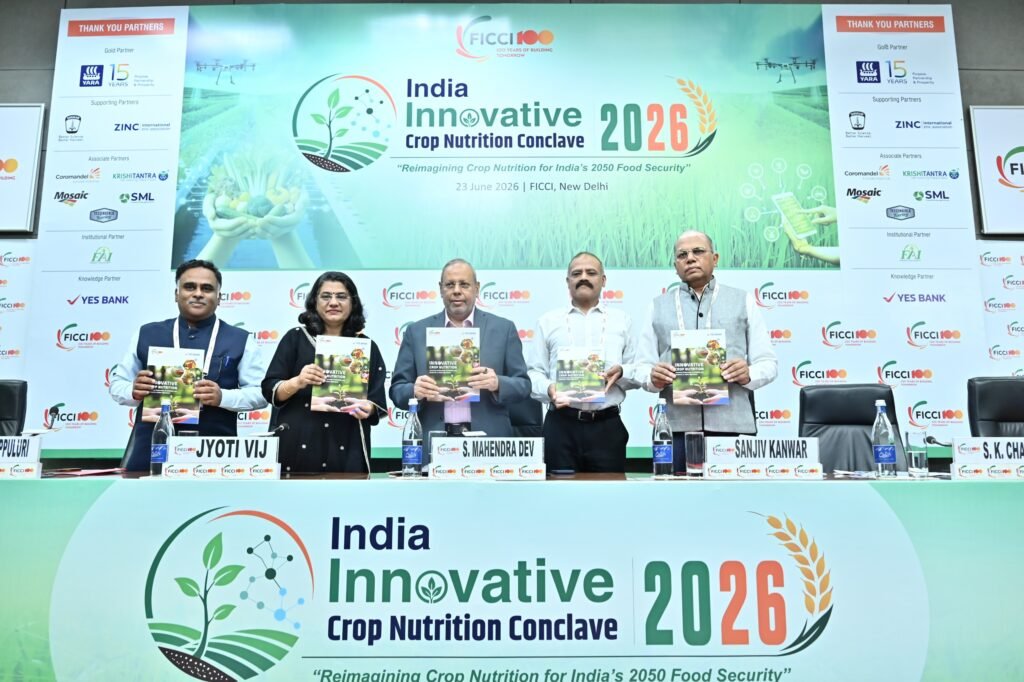
During the event, the FICCI–YES BANK report, ‘Innovative Crop Nutrition: Unlocking Productivity, Profitability and Resilience in Indian Agriculture’, was released.
Mr Sunjay Vuppuluri, National Head- Food & Agribusiness Strategic Advisory & Research, YES BANK, while highlighting the report, stressed the need to transform crop nutrition in India from a fertilizer-centric mindset to an integrated crop nutrition management approach.