





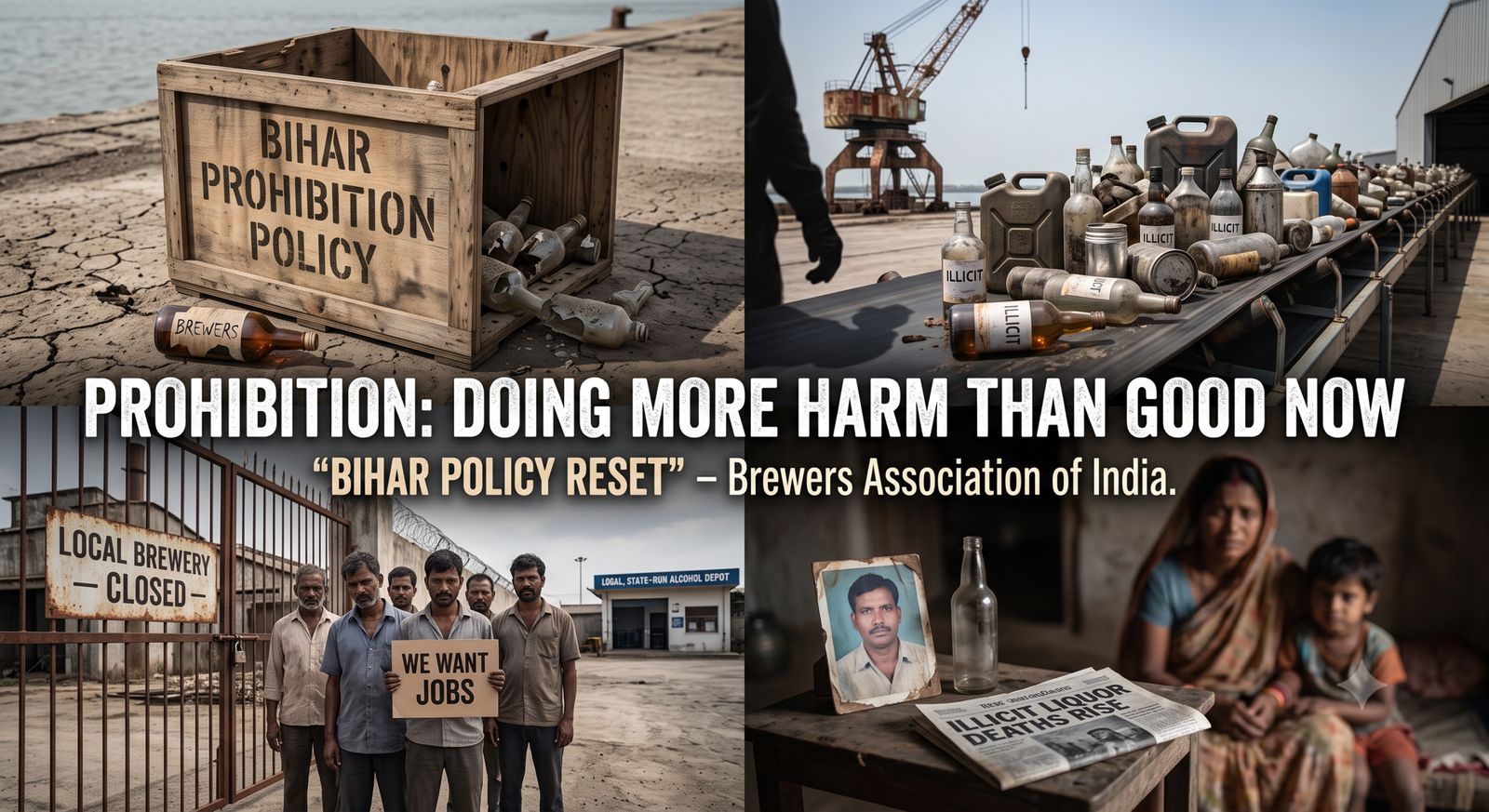
BAI Says Government Let Go Around ₹60,000 Crores in Taxes During Prohibition While Illegal Liquor Economy Flourishes
Patna: The Brewers Association of India (BAI) has urged the Bihar Government to undertake a comprehensive review of the state’s liquor prohibition policy, arguing that the law has failed to eliminate alcohol consumption while creating severe social, economic and administrative consequences.
In a letter to Bihar Chief Minister Mr Samrat Choudhary, BAI Director General Mr Vinod Giri has stated that Bihar stands at a critical policy crossroads and has an opportunity to replace “an ineffective prohibition model with a socially responsible and economically sustainable regulatory framework.”
BAI, the apex body representing India’s largest beer manufacturers including AB InBev, Carlsberg and United Breweries, said the evidence accumulated over the last decade suggests that prohibition has merely shifted alcohol consumption from regulated and taxed channels to an underground and unregulated economy. Representing India’s largest beer manufacturers including AB InBev, Carlsberg and United Breweries,
“Alcohol Did Not Disappear. It Went Underground”
According to the Association, despite one of the strictest prohibition laws in the country, alcohol continues to flow into Bihar through extensive smuggling networks operating across the state’s borders. “Prohibition has not eliminated alcohol consumption; it has eliminated legal alcohol while strengthening illegal alcohol,” Mr Giri said.
BAI pointed out that over 11.3 lakh cases have been registered and more than 17 lakh people arrested under prohibition laws since 2016, while illegal liquor seizures continue to rise year after year.
The Association argued that the policy has diverted enormous police and judicial resources toward enforcement while organised bootlegging networks have expanded across the state.
₹60,000 Crore Revenue Sacrifice in India’s Poorest State
Calling the fiscal implications of prohibition “staggering”, BAI estimated that Bihar has foregone up to ₹60,000 crore in excise revenues over the last decade, in addition to losses suffered by hospitality, tourism, logistics and ancillary industries.
The Association highlighted the contrast with neighbouring states where excise revenues have grown substantially over the same period.
“Bihar today has the lowest per capita income in India, yet has voluntarily surrendered one of the largest sources of state revenue available to any government,” Mr Giri said in his letter.
BAI further observed that the state’s own tax revenues remain insufficient to meet even its annual salary and pension obligations, increasing dependence on borrowing and central transfers.
The Human Cost of Prohibition
The Association argued that the social burden of prohibition has disproportionately fallen on the poorest and most vulnerable communities.
According to BAI, a significant proportion of arrests under prohibition laws involve citizens from economically weaker and marginalised backgrounds, leading to loss of income, legal expenses and long-term social disruption for families.
The submission also drew attention to recurring hooch tragedies in the state, stating that the absence of regulated alcohol markets often drives consumers toward unsafe and illicit alternatives.
“Where legal and quality-controlled alcohol disappears, illegal and dangerous substitutes inevitably emerge,” Mr Giri added.
Global and Indian Experience Shows Blanket Bans Fail
BAI letter cited experiences from Indian states including Andhra Pradesh, Haryana and Kerala, as well as international examples such as the United States’ prohibition era, arguing that blanket bans have historically failed to eliminate alcohol consumption and have instead encouraged black markets and organised crime.
It also referred to recent excise reforms in Karnataka that has restructured taxes to nudge people towards products with lower alcohol content rather than outright ban.
A Roadmap for Responsible Reform
BAI has proposed a phased and carefully regulated approach focused on moderation and harm reduction.
Its recommendations include:
• Introduction of low-alcohol beverages such as beer and wine as the first step.
• Limited rollout in urban areas and economic zones with good regulatory oversight.
• Adoption of alcohol-content based taxation models to encourage lower-strength beverages.
• Creation of dedicated funds for de-addiction programmes and rehabilitation services.
• Introduction of a Women Welfare Cess to channel excise revenues directly into women’s empowerment initiatives.
• Mandating allocation of over 50% of the factory floor jobs to women to support their economic empowerment.
“The Debate Should Be About Harm Reduction, Not Prohibition Versus Permission”
Mr Giri emphasised that the objective of public policy should be to reduce harmful and irresponsible consumption rather than push consumption into illegal markets beyond the state’s control.
“The choice before Bihar is not between prohibition and public welfare. The real choice is between an unregulated black market and a regulated system that generates jobs, revenues and safeguards for consumers and communities,” Mr Giri added.
BAI reiterated its willingness to work with the Bihar Government and policymakers to develop an evidence-based excise framework that balances public health concerns with economic realities.
“The people of Bihar deserve a policy that works. After ten years of experience, it may be time for a fresh conversation based on evidence,” Mr Giri added.