




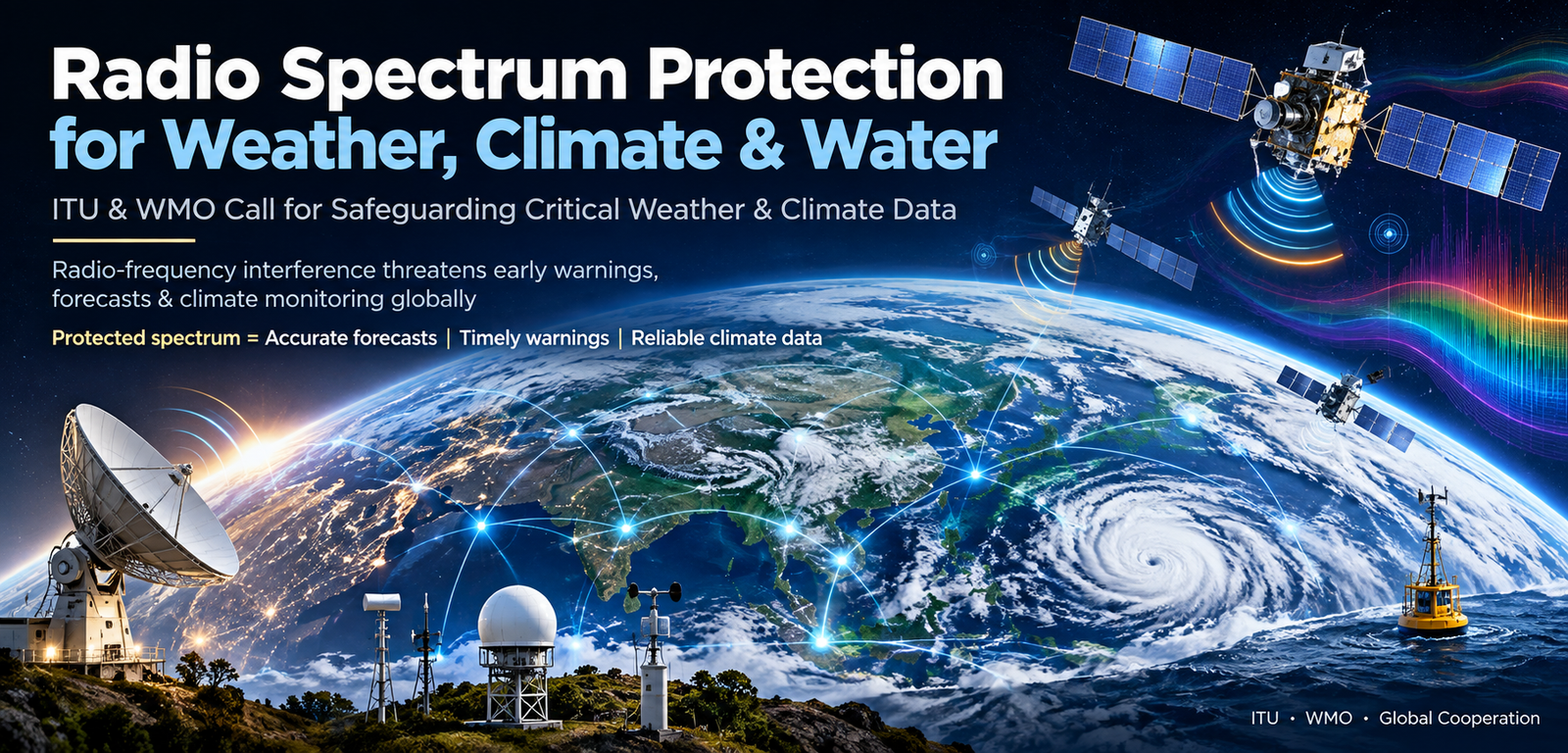
New joint publication provides guidance to safeguard frequencies supporting weather forecasts, early warnings and climate monitoring
Geneva, 28 September 2026 — The International Telecommunication Union (ITU) and the World Meteorological Organization (WMO) call on governments, regulators, and meteorologists to safeguard access to radio frequency spectrum essential for weather forecasts, early warnings, climate monitoring and water management.
The appeal comes with the release of a new joint handbook, the Use of Radio Spectrum for Meteorology: Weather, Climate, Water and Related Environmental Applications.
The new publication offers updated guidance on the use and protection of radio frequencies supporting critical meteorological systems. These systems enable observations of the atmosphere, oceans, and land, and the transmission of data that supports life-saving early warnings, reliable weather forecasting, and long-term climate monitoring.
The ITU-WMO handbook, formally released at the opening of the Global ITU-WMO Seminar on Spectrum Use for Meteorology, also highlights the potential impact of radio-frequency interference on the accuracy and availability of essential environmental data.
“Preventing harmful radio interference is a matter of public safety and can save lives,” said Doreen Bogdan-Martin, Secretary-General of ITU. “Interference-free spectrum keeps weather forecasts accurate, emergency alerts and warnings timely, and climate data reliable — so communities can prepare, respond and build resilience.”
“The radio-frequency spectrum is a finite natural resource. Meteorology relies on specific bands — determined not by choice, but by the physical properties of the atmosphere itself: they enable observations that no other frequencies can provide. These bands must be protected,” said WMO Secretary-General Celeste Saulo. “Protect the spectrum that lets us observe the atmosphere, and we protect forecasts and early warnings on which every country depends.”
Some satellite sensors measure very weak naturally occurring signals at specific frequencies, making protection from harmful interference particularly important. Weather radar, lightning location systems, aircraft and marine observations, hydrological monitoring systems, and other platforms also rely on these frequency bands to collect and exchange data.
Protecting a critical global resource
Experts at the WMO-ITU event will review recent and upcoming international spectrum decisions relevant to meteorological and Earth observation services, including outcomes of the latest ITU World Radiocommunication Conferences.
The event comes as the demand for wireless communications, satellite services, and environmental data continues to grow, underscoring the importance of ensuring continued access to, and protection of radio-frequency spectrum for Earth Observation.
Radio frequency interference can degrade the accuracy and availability of vital data needed for early warning systems, weather forecasting, and climate monitoring. Such impacts can affect the ability of governments and communities to prepare for and respond to environmental hazards.
Bringing technical, operational, and regulatory guidance together in one resource, the new handbook supports informed decision-making on spectrum management and promotes collaboration between the meteorological and radiocommunication communities.
The Global ITU-WMO Seminar on Spectrum Use for Meteorology: Challenges, Opportunities, and Evolving Requirements takes place at ITU headquarters in Geneva from 28 to 30 September 2026.