








New Delhi, 17 June 2026: India’s energy security challenge is no longer just about how much coal, oil, and gas the country imports. The deeper risk is that India’s fossil fuel system is exposed across the board — through concentrated suppliers, vulnerable shipping routes, limited reserves and storage, refinery constraints, and direct exposure to global price volatility, according to a new independent study by the Council on Energy, Environment and Water (CEEW), How Secure is India’s Energy Future? Assessing Accessibility, Reliability, and Affordability, released today.
India imported 88 per cent of its crude oil, nearly 48 per cent of its natural gas, and about 26 per cent of its coal in 2024. Fossil fuels accounted for over 28 per cent of India’s total import bill in 2024–25. It also accounts for 8.6 per cent of global oil imports, ~4 per cent of global LNG trade, and ~15 per cent of global coal imports. The CEEW study highlights that India’s energy security risks are now spread across households, industry, public finances, inflation, and strategic autonomy. The study assesses India’s key fossil fuels — coal, oil, and natural gas — through three energy security lenses: accessibility, reliability, and affordability.
Hemant Mallya, Fellow, CEEW, said, “India has strengthened energy access, diversified supplies, and scaled clean energy. However, our study shows that energy security risks are becoming more complex. Disruptions in crude oil, LNG, LPG, coal, or key shipping routes can quickly affect cooking costs, transport fuel prices, fertiliser subsidies, industrial competitiveness, and inflation. India’s next phase of energy security must move beyond securing fossil fuels to a clear transition plan: optimising gas system utilisation, avoiding further refinery expansion, accelerating viable EV adoption, electrifying industry, reconfiguring refineries for lower gasoline demand, and building resilient green technology supply chains.”
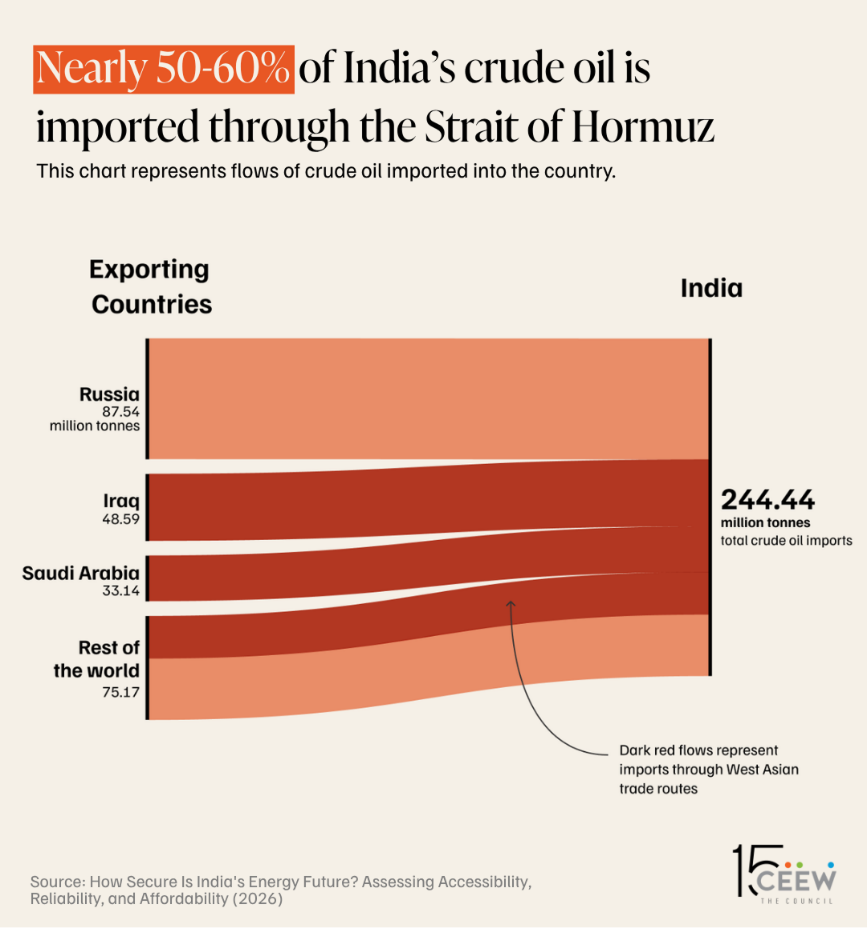
India’s crude security is constrained by six suppliers and refinery limits
The CEEW study finds that over 85% of India’s crude imports come from just six countries, including Russia and West Asian countries, limiting flexibility during supply shocks. This risk is further compounded by refinery configurations that restrict the range of crude grades India can process economically. The study recommends diversifying long-term crude sourcing to suppliers such as Brazil, Guyana, and West Africa, modernising refineries, and preparing a national refinery transition plan.
India’s oil reserves cover 9–10 days; gas has no strategic storage
The CEEW study finds that India’s strategic petroleum reserves cover only 9–10 days of net crude imports, plus 64 days in refinery operational stocks — far below other major import-dependent economies such as Japan, which holds ~200 days, and South Korea, which holds ~207 days. For gas, India imports nearly half its supply as LNG but has no dedicated strategic gas storage, leaving fertiliser plants and city gas networks exposed. The study recommends mandating and commercialising oil, gas, and LPG reserves, including emergency stock obligations, gas storage in depleted wells, and expanded underground LPG storage.
LPG is India’s hidden household energy-security vulnerability
LPG is the cooking gas used by over 330 million households (measured by active domestic connections), yet nearly 95 per cent of India’s supply depends on imports, either directly or through domestically produced LPG that relies on imported crude oil. As previous CEEW studies show, petrol demand peaking by 2032 and declining thereafter, refineries will accumulate excess naphtha that could be converted to LPG, reducing import dependence. Until refinery configurations are re-aligned, a disruption in global LPG supply puts cooking gas for hundreds of millions of homes at risk.
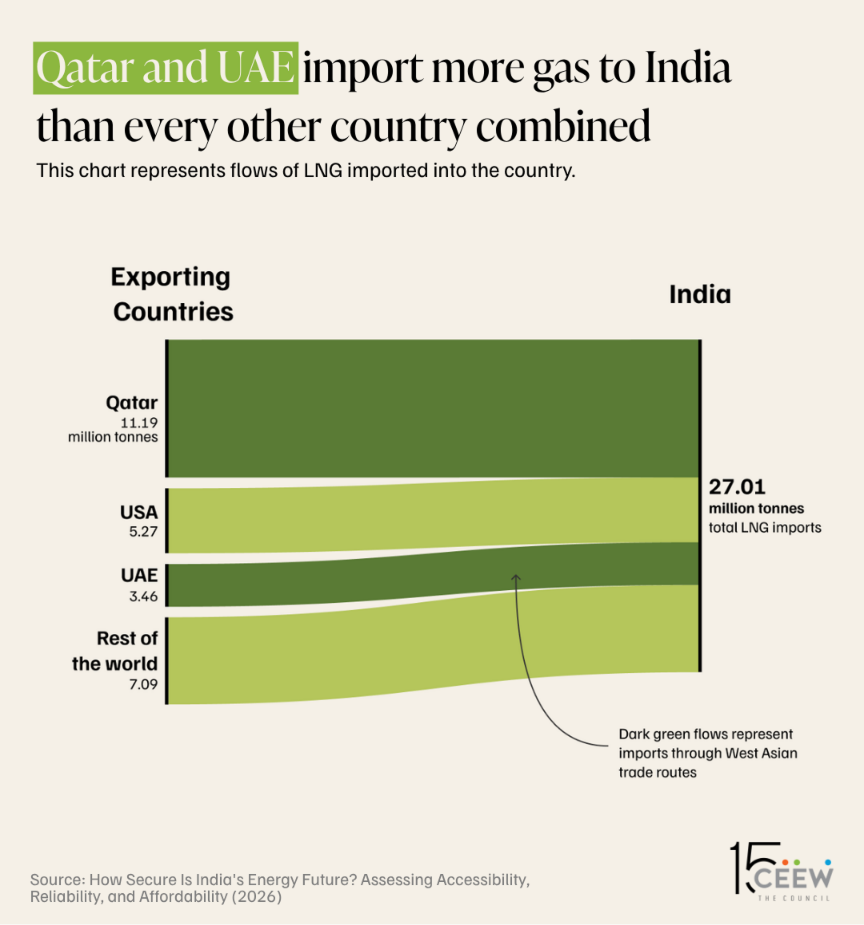
Imported gas could raise CNG prices by 15–17% under high-price conditions
The CEEW study finds that affordability risks are most visible in the gas sector. The study estimates that if the share of imported gas in city gas distribution rises from 15 per cent to 50 per cent, CNG prices could increase by 15–17 per cent under high global price conditions. This could weaken the role of CNG as an affordable transition fuel, especially for transport consumers. The study recommends increasing the share of natural gas hub-indexed LNG contracts, such as Henry Hub-linked contracts, to reduce exposure to crude-linked price volatility and improve gas affordability.
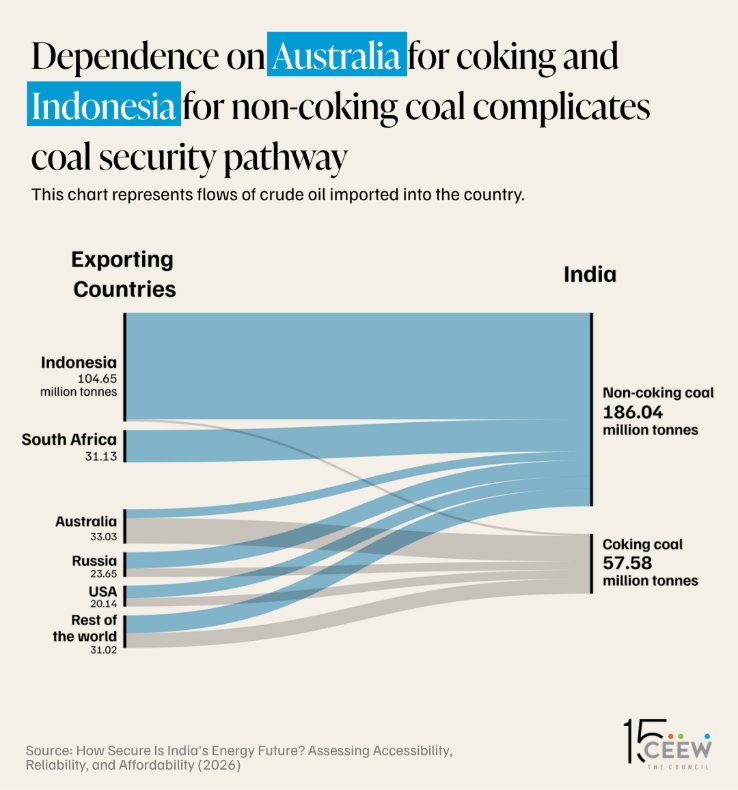
India’s coking coal imports warrant stronger supply chain planning
The study finds that India’s coal security risks are increasingly shaped by continued dependence on imported coking coal — particularly from Australia — for steelmaking, and exposure to Indonesian export policies for non-coking coal imports. On the domestic side, declining coal quality and rising production costs signal a narrowing cost advantage for coal power over firm renewable power. The study recommends that India develop a dedicated coking coal security pathway — including diversification of import sources, strategic stockpiling, and longer-term supply agreements — to reduce vulnerability in the steelmaking sector, which accounts for the dominant share of coal imports.
A strategic clean energy transition could be India’s security hedge
The CEEW study argues that clean energy can reduce India’s exposure to continuously imported fossil fuels. Unlike coal, oil, and gas, renewable energy systems rely on domestically available energy sources once installed, reducing vulnerability to fuel supply shocks, shipping disruptions, and global fuel price volatility. However, the study also cautions that clean energy creates a different kind of strategic dependence: critical minerals, technologies, and industrial inputs. This dependence must be managed through domestic manufacturing, supply-chain diversification, recycling, and strategic international partnerships.
Recommendations
The study recommends five immediate priorities: mandating and commercialising strategic oil, gas, and LPG reserves; accelerating EVs where it’s already commercially viable and LNG for heavy freight; preparing a national refinery transition plan; and promoting electric cooking to reduce dependence on LPG imports. Over the medium and long term, it calls for diversifying crude and LNG supplies, expanding hub-indexed LNG contracts, modernising refineries, aligning infrastructure with future demand, selectively developing domestic resources, and accelerating electrification-led demand substitution. India’s energy security strategy must now shift from managing fossil fuel supply risk to reducing fossil fuel exposure through clean energy, electrification, strategic reserves, and resilient technology supply chains.